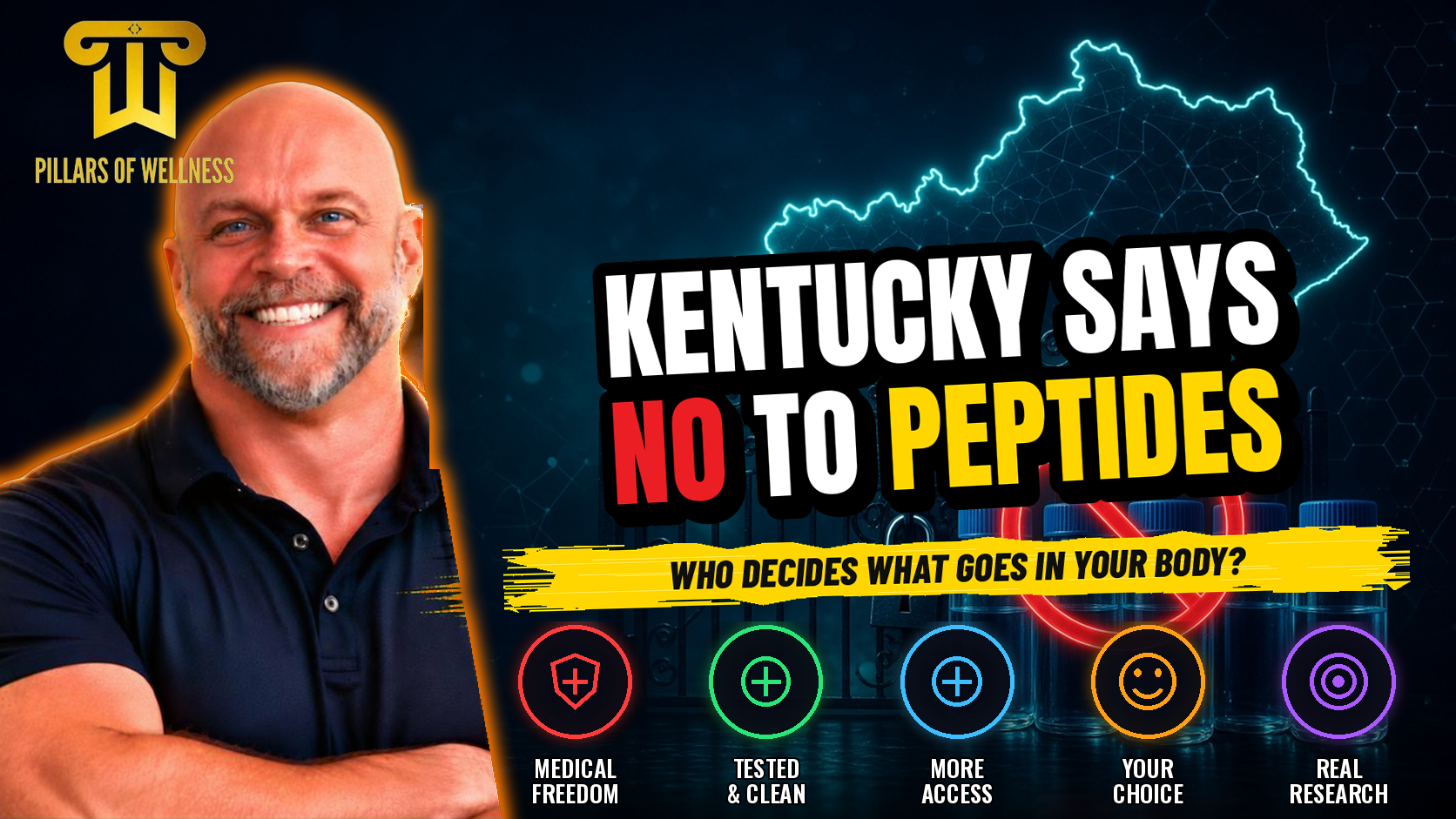

In this episode, Dr. Matt Chalmers, DC, CCCN, CCSP, breaks down Kentucky’s decision to block compounded peptides like BPC-157, TB-500, MOTS-c and KPV, even after HHS said it would not enforce against U.S. pharmacies making them. He explains what the state’s reasoning was, what it means for people who rely on clean, tested peptides, and why he sees this as a medical freedom fight.
His bottom line: you own your body, not the government. Nothing should be illegal until it’s proven harmful to society, false marketing should be held accountable, and people should be free to make informed choices with a provider, testing and personal responsibility.
After HHS and RFK Jr. said the federal government would not enforce against U.S. compounding pharmacies making certain peptides, Kentucky said no. Because those peptides aren’t on the FDA-approved list or the bulk list for compounding pharmacies, the state decided they can’t be compounded or shipped in. Pharmacies working to GMP and USP standards can no longer send them to Kentucky residents.
The practical result, Dr. Chalmers points out, is that people in Kentucky are left with whatever they can find online, often from overseas sources with unknown quality. As a free-market guy, he believes more access and more options drive the price down and the quality up every time.
The bigger issue is medical freedom. Individuals own their bodies, not the government, and the government shouldn’t get to decide what we put in them. In his view, nothing should be made illegal until it has been shown to cause significant harm to society, not just to an individual.
The healing peptides like BPC-157, TB-500 and thymosin alpha-1 have been used by millions of people who report real benefit, without significant problems showing up for this group. Telling people they can’t have something because the government hasn’t decided whether it likes it yet is, he says, the wrong direction.
Dr. Chalmers agrees a lot of peptide marketing is trash. Your ACL isn’t going to heal itself in 10 days. Companies that make false claims should be held accountable, the same way those who claimed opioids weren’t addictive should have been. Regulating what’s said is fair. Taking away access isn’t.
Freedom comes with responsibility. If you buy peptides from an unknown source and have a problem, that’s on you. In his practice, patients can bring their own peptides as long as they have a certificate of analysis (COA) from the lot they came from, because he won’t work with anything when no one knows what’s in it.
If the government truly cares about safety, it should do the testing first: track thousands of people using a peptide for a year and report what happens. Even if that can’t prove a peptide heals you, it can show whether it’s safe enough for people to choose for themselves.
Chronic disease and spending on it have climbed for 30 years, even though root causes like hormones, diet and inflammation can be fixed. Dr. Chalmers notes that at least one other state has threatened doctors’ licenses just for discussing these peptides. His call to action: tell your elected officials you want more medical freedom.
The overarching message: Kentucky’s rule takes clean, tested options away and leaves people with less safe ones. Stand up for medical autonomy, hold false marketing accountable, test what you use, and work with a provider who checks your labs and follows up. You get to decide what goes into your body.
Related: The RFK Peptide Change: Why Single Peptides May Disappoint You · Carding Kids for Protein and Creatine? Why California’s New Rule Gets Health Wrong
Transcript lightly edited for readability (filler words and repeats removed). Some off-topic commentary has been removed.
All right, so for those of you who don’t live in Kentucky, what Kentucky did was they came out and they said that they’re going to reject any peptide creations, shipping in or utilization in their state because the FDA has not given clear clearance to the peptides and what we’re talking about peptide wise is that we’re talking about BPC, TB-500, MOTS-c, I think KPV. The peptides that HHS and RFK Jr. Said, we’re not going to enforce this if you guys want to start making them so that we have cleaner versions that were made here in the United States versus the questionable ones that were made elsewhere in the world, go ahead and make them, we’re not going to enforce the laws on these things. Which you can argue back and forth whether that’s better to let unknown peptides be circulating like the state or to have the ones that we know were tested and made here or whatever circulating around the state, that’s an argument you can have. There’s upsides and downsides about that argument.
So that’s not the place I want to go with it. The reasoning that Kentucky had was that their laws state that they can only do these things that are on the bulk list for compounding pharmacies or that are on the approved FDA list. So anything that’s on those two, they don’t have any say on. So which, all right, you know, that’s fine. As far as government rules go, you know, delegating all authority to the federal government from a state, I think is a little bit weird.
But that’s what they did. And so they came back and they said, since the federal government has not made them legal, they just said they weren’t going to enforce the laws around them. That they are not legal in the state and they cannot be compounded. Anybody who compounds them, so any pharmacy, like the ones I work with who work here in the United States and make things in the United States up to GMP or up to USP pharmacy standards, those cannot be shipped into the state. And so what you’re gonna only be left with is whatever you can find on the internet.
Which, again, you can argue back and forth on whether or not you think that’s a good idea or bad idea. I think more, I’m a free market guy, so more access is always beneficial. More options are always beneficial, drives the price down, drives quality up every time. But that’s not where they went. Now, the bigger piece on this is that I want to discuss is the medical freedom piece. I think we should start pushing back and telling the government that we as individuals own our bodies, not the government and that the government doesn’t get to decide what we put in them.
This is a, this is a major issue. So you know, at the end of the day, this is a medical freedom issue. It is my belief, and you guys obviously, everybody gets their own opinion on this, that the government should not be allowed to make anything illegal. Now, if we want to say that you can’t bring stuff in from Mexico, you know that argument, but they can’t make anything illegal until it is shown significant damage to society, not to an individual. So for instance, you look at the opioids and when we get lots of people addicted to opioids because the pharmaceutical groups came out and lied to everybody and told them that they weren’t addictive when they obviously were and they knew that going in, but different story.
That destroys society. And so obviously we need to kind of temper that back down and get that under control and you know, that type of thing. Fine. Don’t really have an issue with that. It’s been a proven thing. However, when we come out with peptides and we’re like, oh, millions and millions of people have used these and millions of people have talked about the significant benefit they’ve gotten from them. And we’ve not seen any significant issues with this group.
We see them with some of the other ones, but not with this particular group we’re talking up with the healing peptides, the BPC, the TB-500, like those guys, thymosin alpha-1. We should start looking at this and be like, look, we can’t tell you if it’s good or bad. And I’m fine with hammering on the marketing and being like, you guys don’t have the information to say that this does the things you’re saying it does. That’s fine too. But telling people they’re not allowed to have something because the government hasn’t decided yet if they like it or not, I think is a problem that we need to stay away from.
And the reason for that is because if you look at everything that’s going on from the FDA, all of the things that they have said and done in the past have been detrimental to our health. So you look at the idea when they came out and they said that margarine’s better for you than butter. And they said that formula was better than breast milk. When they said that steak, they said that Lucky Charms was better for you than steak. When they’ve told us this entire time that eggs, you should never eat and you know, all that’s terrible for you know, but it’s okay to smoke cigarettes and drink alcohol.
You know, that’s totally fine. These types of things, as we go through, create issues. And when we can’t look at a specific group because they’re corrupt or because they have the potential to be corrupt, then we need to have more freedom of choice for ourselves. Now, having said that, if you decide that you’re going to run some peptides, good for you. But if then you come out and you decide that all of a sudden, you know, you’re going to buy them, you know, from Joe down the street and he gets them from Mexico or China or Indonesia or wherever, and you end up having a problem.
Well, that’s on you, because you made that decision. And I realize right now in this country, personal responsibility is a thing that is kind of foreign to a lot of us, but that’s kind of where it is. So, well, okay. So a viewer asked whether dangerous products being mislabeled and sold in the name of medical freedom is really freedom. Again, you know, yeah, you know, again, if you’re, depending on how you’re getting these things, you need to take personal responsibility.
Like I talked to people all the time, like when people go out, well, can I use my own peptides when I come work with you? Sure. You can use peptides from wherever you want to, if you want to come work with us. They have to have a COA from the lot that your peptides came from. That’s it, because I won’t work with people who we don’t know what’s in their stuff. Again, I get my stuff tested, you can get your stuff tested, you can choose to get these things tested if you want to, and you can find out what’s in them.
You can go through and do the research, you can read what’s going on, you can do the proper stuff and decide maybe or maybe not on the statement that I just made about how we knew it was dangerous and deadly guys, we’ve known opioids and opium was addictive for two, 300 years. Like if you go back and like chasing the dragon, chasing the dragon was one of the, was used for the opium houses, the poppy dens, where people would go in and get, they were so addicted, they had to keep going to these things. So yeah, we’ve known for a very long time. Putting a candy coating on the top of it isn’t going to make them less addictive. And we knew for a long time that they were addicted before we came out and said anything about it.
As I say, we, the medical industry, So we knew that one was bad going in. So I mean, take that one for what it’s worth. Because that’s really where this thing comes down to. The idea that we have to listen to the government, we have to trust the government and whatever information they put out has to be the standard and has to be golden is a problem for me. I think that we should have more personal responsibility and thus freedom on the individual should be responsible for figuring out what they need and what they don’t need and how they’re going to use it and how they’re not.
And if they get hurt by it, well, that’s them. Now, if we have a marketer, we have somebody who’s legitimately saying things that aren’t real, like opioids aren’t addictive, they should get sued. They should get crushed in court. They should be run out of business. They should be held criminally liable for these things. That’s where it should be. That marketing function should 100% be illegal. Now, having said that, let’s look at what’s going on with the peptides.
Let’s just look at BPC-157 just as a beginner. I will tell you that I think some of, if not all of, but a decent amount of the advertising for it is trash. Idea that you’re like, oh, I just took this and like my ACL healed itself in 10 days. That’s not going to happen. Significant increase in healing, regeneration and function. Yeah. We see tons of benefit from it. Can it do all the things that the marketing says it can? Not entirely. So I think there should be some regulation on what is said in that manner.
Or you said X didn’t happen, you’re in trouble. That type of a thing. But deciding that no one can get them in your state, because the government hasn’t given it a seal of approval for whatever reason, I don’t think it should be the limiting reagent. Now, if the government wants to come out and be like, all right, you guys are using these things, we do care about your safety. So we’re going to do extensive testing, and then decide, you know, here’s the testing we have, and here’s where we’re seeing it going.
Great. Has that been done? No. They’re like, there’s not enough research. Well, do some. Figure it out. Do the safety testing first. All you’ve got to do is be like, all right, we took 10,000 guys, we gave them all BPC-157, tracked them for a year, nothing negative happened. So while we can’t argue that it’s going to heal you, we can tell you it’s not going to kill you. And so you can use it if you want to. So that’s where a lot of this stuff should be, but it’s not.
Because again, you have to understand. When you make money off of people being sick, you have to have people that are sick in order to make money. So if all of a sudden people are taking health into their own hands and they’re fixing their hormones and they’re fixing their diet and they’re healing better and all these things and all of a sudden they stopped going to the medical industry, they stopped listening to all the stuff from the FDA and the NIH and the CDC and they start listening to guys like me and all of a sudden their diseases start going away and all of a sudden their quality of life starts coming up and all of a sudden they start realizing that the medical industry that is literally, this isn’t something that I’m making up, this is how they change their doctrine to management of disease. So they’re going to make sure that you keep your disease, but we just keep it in a little box as it goes along. They understand that the root causes are creating the diabetes, creating the chronic fatigue, the fibromyalgia, creating these whatever the long-term chronic issues are not being helped.
And so you’re going to get secondary and tertiary issues that then require secondary and tertiary medications. They understand that. And that’s their goal. Because the sicker you keep the population managed, the more you get to charge them every day for their problems. So if all of a sudden someone steps in and goes, oh, we’re going to fix that issue. You don’t have PCOS anymore. You don’t have endometriosis. You don’t have type 2 diabetes. You don’t have like all of a sudden, the need for their drugs goes away.
So factor that in. Look at the fact that our chronic diseases, which we can fix, we know how to fix. We fix them all the time. Have gotten worse over the past 30 years. By worse, I mean the amount of people who have them and the amount we’re spending on them has gotten a bit higher every single year. So our problem is getting bigger. We’re spending more money on it. And what we’re being told is that the people who are making the money off of this, they’re working on ending it so that they don’t make any more money and you don’t have the disease anymore.
Whether or not we want to call this a flat out lie or not is up to you. However, we’ve been seeing it get worse every single year for the past 30 years. We do know how to fix all those things. And right now we can fix them really quick. Like diabetes used to take me six months to a year, you know, to really kind of narrow down. Now it’s taken me four to six months in a lot of cases. So it’s twice as fast, super easy. And we’re reducing significant other issues as well, like heart attacks and strokes and cancer and things like that.
Again, we’ve known how to fix these things for a long time. However, it’s more profitable to maintain them than it is to actually fix them. This is the same group of people that are coming out and saying that, you know, we’re worried about safety with peptides. So this, the government coming back and saying that you can’t have you can’t ship them, can’t use them, I think is the wrong direction. And I think what we should do as a society is be like, no, sorry, government.
We own our bodies, we have rights over our bodies, we get to decide what goes in and what goes out. You cannot keep things away from us that have not been proven dangerous. And so if you want to ban something, prove its danger, prove its problem, prove its danger to society, not an individual. And then we can start talking about laws that prevent us from using it. That would be the way that I would want it to go. But anyway, the Kentucky rule is a horrible idea.
I hope it doesn’t spread out across the country. I know that there’s some other States who have said that if a doctor was to use BPC or to recommend BPC or talk good about BPC or any of those peptides, they’d lose their license. And so that is a big issue. So that’s one of those things we kind of have to kind of factor in is who’s in charge and why are we allowing people to do things and keeping other people from doing it. So which I think that last one, and it was Alabama who did that.
So if you come to me and you ask me questions about a peptide, and I give you the answers, and you go home and buy it and use it, I can lose my license, because I gave you literally, or let’s say a medical doctor, gives you actual medical information doesn’t sell them to you doesn’t you know doesn’t but says all right you can use that we’ll put it into your plan because you’re already using it so I put it in your chart so I know it’s there they can lose their license for that so just understand where the fight really is they’re not they’re pushing back really hard they’re trying to keep it right from having these things but they’re trying really hard to make it look like it’s for some other reason so factor that into your decision-making as you’re going through and thinking about this and if you’re gonna vote tell your politicians that you want some more medical freedom. That’s where this case really comes down to. You guys have any questions? Let us toss them in the DMs. Love to have that conversation.
You guys have a fantastic day. Thanks for your time.
Check out PillarsOfWellness.com for Wellness updates! And ask me any questions you have at questions@chalmerswellness.com.
I answer them all and look forward to hearing from you.
Comment, like, and interact with other people on their wellness journey. Communities can make a difference. DrChalmers.substack.com
Check out my website: https://pillarsofwellness.com/
Social Channels: Instagram: https://www.instagram.com/drchalmers1/
Facebook: https://www.facebook.com/ChalmersWellness
LinkedIn: https://www.linkedin.com/in/matt-chalmers-a422803b/
Dr. Matt Chalmers
Disclaimer: This content is for informational purposes only. Before taking any action based on this information, you should first consult with your physician or health care provider. This information is not intended to be a substitute for professional medical advice, diagnosis, or treatment. Always seek the advice of your physician or other qualified health providers with any questions regarding a medical condition, your health, or wellness.