
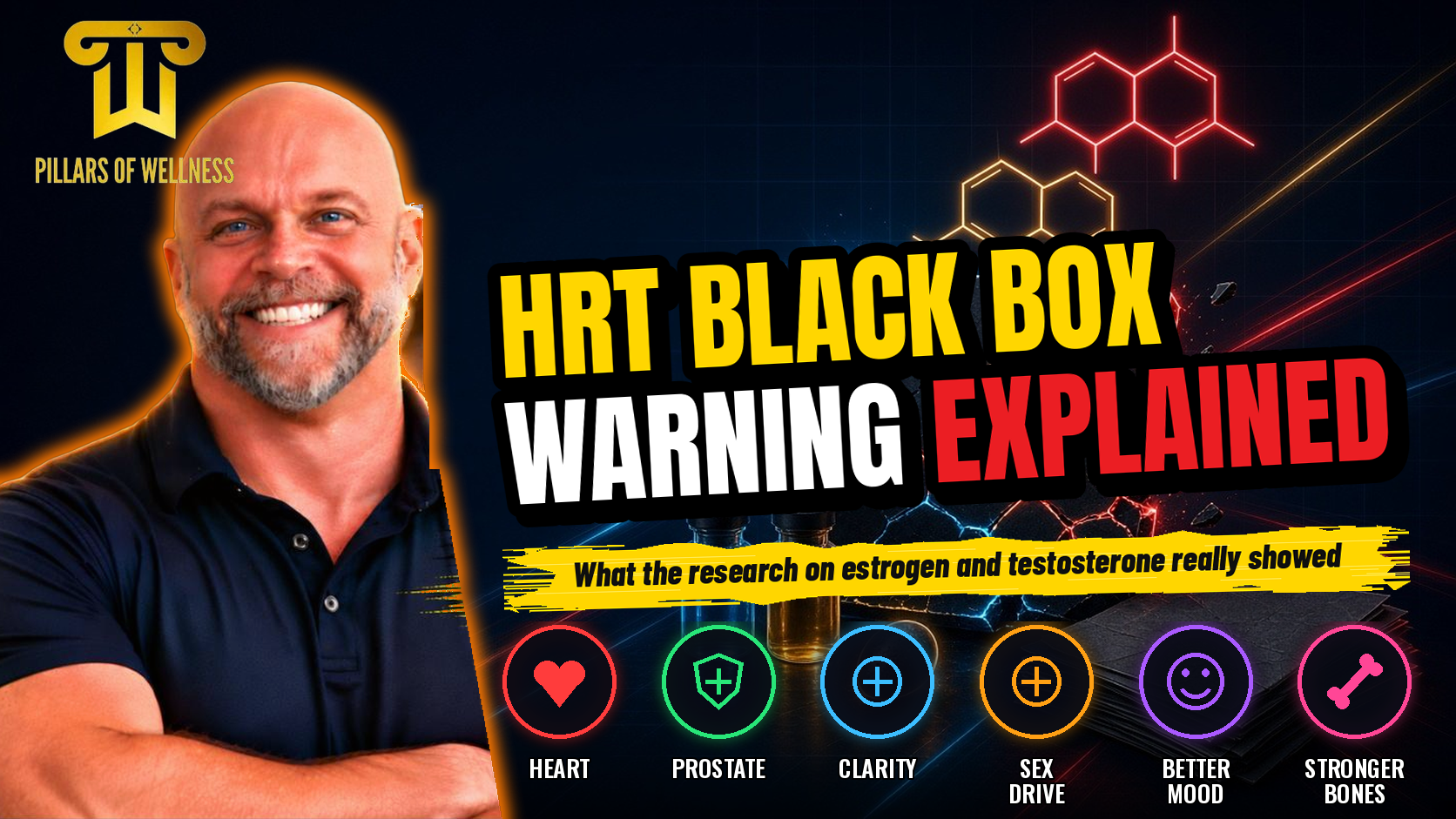
In this episode, Dr. Matt Chalmers, DC, CCCN, CCSP, answers a question he’s been asked again and again: why were there black box warnings on hormone therapy, and why were they removed? He walks through the Women’s Health Initiative behind the estrogen warning, the testosterone studies that fueled heart and prostate fears, and what later research actually found.
His bottom line: the scary findings came from synthetic hormones, given to women long past menopause, and from testosterone studies with serious problems. Bioidentical hormones, started early and managed well, tell a very different story. Testosterone, estrogen and progesterone are critical nutrients your body requires to function the way it was designed.
This episode was streamed live on Thursday, November 19, 2026. Watch the original live stream on YouTube.
A black box warning is the strongest warning there is: this is dangerous, don’t use it. The estrogen warning came from the Women’s Health Initiative, a trial stopped early in 2002 over concerns about heart disease, stroke, breast cancer and later dementia. In 2025, an FDA expert panel had that wording removed, along with the old “lowest amount for the shortest time” language. The endometrial cancer warning did stay.
The trial followed 16,608 women for 5.2 years on oral Premarin and Provera, a synthetic progesterone like the kind in birth control. Per 10,000 women per year, there were seven extra heart events, eight extra strokes, eight extra blood clots in the lungs and eight extra breast cancers, but also six fewer colon cancers and five fewer hip fractures, and overall deaths didn’t go up. In the estrogen-only arm, breast cancer was actually lower with hormone replacement than without.
Synthetic hormones can’t be structurally, chemically or functionally identical to natural ones. They were designed to activate the same receptors in a different way, and they didn’t get it right. With bioidentical hormones, Dr. Chalmers says, we don’t see these issues nearly as much, which is why the industry has shifted away from synthetics.
The women in the trial were mostly 65 to 79, years past menopause, with systems that had been shut down for a long time before anyone tried to restart them. It’s easy to slow the clock down and hard to turn it backward. Get your hormones tested in your 20s and 30s and start managing them earlier for a smoother ride through menopause and a much higher quality of life.
The 2010 TOM trial was stopped early because the testosterone group had more cardiovascular events, mostly swelling and blood pressure changes, not heart attacks or heart failure. Large shots once a week or every 10 days create big swings, so the issue is often how testosterone is taken. A 2013 study in JAMA drew requests from more than 100 medical groups to retract it: about 1,100 men were listed as excluded when they weren’t, about 100 of them were women, and the raw numbers actually showed fewer events in the testosterone group before heavy statistical adjustment.
The fear goes back to a 1941 study suggesting lower testosterone shrank prostate cancer, which led to the untested assumption that more testosterone must be harmful. When the TRAVERSE prostate study looked in 2023, high-grade prostate cancer was rare and not significantly different: about 0.19% with testosterone versus 0.12% without, well within the margin of statistical error.
A generation of doctors was taught that hormones cause cancer, heart attacks and strokes, and many grew up with messaging that cast testosterone as something that turns people into rage monsters. Your doctor is likely repeating what he was taught. Restoring hormones restores function, and that can reduce the need for a lot of other treatments for sex drive, mood, energy and mental clarity. Read the research yourself and come to your own conclusion.
Testosterone isn’t a male hormone. Women make testosterone first and convert it into estradiol through aromatization, so Dr. Chalmers recommends starting women with testosterone while working on estrogen and progesterone. It often means less estrogen is needed. And for teenagers dealing with depression or focus problems, have someone check their testosterone, then pair it with lifting, red meat and sunlight.
The overarching message: the black box warnings were built on synthetic hormones, much older patients and flawed testosterone research. Testosterone, estrogen and progesterone are critical nutrients your body requires. Whatever the reason your levels are low, getting them into a functional range, along with reducing inflammation and dialing in nutrients, exercise and sleep, is how you maximize health and quality of life.
Related: Hormones Are Commands: Why You Can Still Feel Tired With “Good” Hormone Levels · “Research Says”: How to Tell Good Health Research From Bad
Transcript lightly edited for readability (filler words and repeats removed). Some off-topic commentary has been removed.
All right, so a lot of people have been asked this four or five times from different people. And so I want to go through the black box warnings for hormone therapy, testosterone, estrogen progesterone, kind of explain why they were there, that type of thing, and why they were removed. So we’ll start with estrogens. I want to read this so that we get it all exact. So the FDA black box warning, so a black box warning is where it’s like, this is super bad.
Don’t use it’s causes all sorts of problems. Like don’t ever do it. So the black box on this one, what they said was it came from the women’s health initiative in January of 2003. They were using synthetic progesterones and synthetic estrogens in this trial. And it was stopped early in 2002. Worrying about heart disease, stroke, breast cancer, and later dementia. After the, there was an FDA expert panel that got together in 2025 and had all that stuff removed, the, they also removed the idea that the lowest dose for the shortest time, they pulled that wording as well, because you can have more hormones than this.
What actually showed was, the endometrial cancer warning did stay. So what that research showed so the women’s health initiative had 16,608 women in it That was stopped after 5.2 years They were taking oral Premarin and Provera is a synthetic progesterone, the same type of thing that’s in birth control. The average age was 63 per 10,000 women per year They were seven extra heart events eight extra strokes eight extra blood clots in the lungs eight extra breast cancers. They were also six fewer colon cancers and five fewer hip fractures. Overall deaths didn’t go up.
The estrogen only arm showed more strokes, but no increase in heart disease and breast cancer was actually lower in the hormone replacement group than it was without. So it’s a, it kind of showed a little bit opposite of what people are thinking. They think that these things cause cancer and they don’t like even the study that with the synthetic stuff was showing that it was preferable to nothing. What we’re seeing is that it was causing blood clots and things like that. Again, hormones are commands.
When we make synthetic hormones, they cannot be the same structurally, chemically, or functionally as a natural hormone. So what they were actually trying to do was make something completely different that would activate the receptors the same way that the natural progesterone and estrogen do. The problem is that they didn’t get it done right. That’s the entirety of what’s going on. When you use actual synthetic, when you actually like bioidentical hormones versus the synthetic, we don’t see these issues nearly as well as bad.
And so that’s one of those big things that we kind of have to bring in. So the big criticisms where this is that all these women between 65 and 79, so they’re all way past menopause, they’ve been having this damage for a long time, the system’s been shut down and you’re jump-starting it again, it’s really easy to slow the clock down. It’s really hard to turn it backwards. So all these women need to get tested early in your 30s, in your 20s, 30s, start figuring out where your hormones are at and start managing them earlier. You will have a much better ride through menopause and everything else, and your quality of life will be way higher.
So start early, because again, this is one of the biggest things there were 65 to 79 year old women. And so the physiology is going to be a little bit different. Now testosterone, there was never a, like a black box warning necessarily on testosterone, there’s just normal, you know, heart stuff was related to it, and the way they got that was they did a study with a bunch guys. And the problem was, it was called the Tom trial. It was in 2010. It was stopped early because the testosterone group had more cardiovascular events.
23 verse five, those events were mostly, from swelling and blood pressure. So it wasn’t like they’re having heart attacks. It wasn’t like their hearts were failing. Their blood pressure went up a little bit and they’re like, man, let’s stop this. Which again, if you’re doing shots once a week or once every 10 days in large amounts, you’re going to create more swings like that. So we now know that’s not even a thing that’s necessarily with the testosterone.
It’s the way you’re taking it. And the giant blood swing changes that your body gets if you do a whole bunch it all at once. So that’s where the majority of this is. They actually had to go back and redo this because so many people looked at it and were like, this is crazy. So what ended up happening was that they took more than 100 medical groups asked for it to be retracted. This is the sorry, the Vigen study, 2013, in JAMA. More than 100 medical groups asked for it to be retracted.
It had listed about 1100 men as excluded when they weren’t, and about 100 of those were women. So this isn’t a men’s trial, and a bunch of the guys who were not supposed to be grouped in with this, they left in, and so it completely skewed the data. And what’s funny is that the raw numbers actually showed fewer events in the testosterone group than in the control. However, they showed a 29% higher risk, which stated is after heavy statistical adjustment. On prostate cancer, there’s never been a box warning or anything there’s just a little bit of stuff on it what happened in 1941 was there was a research done where the lower testosterone, they think they feel like it made processed cancer shrink, but then so they thought, well, less testosterone is beneficial, so more testosterone is obviously harmful.
Well, they never studied that, but when they went back and studied it in the TRAVERSE prostate study in 2023, high grade prostate cancer was rare and not significantly different with testosterone, which is about 0.19% versus without testosterone, which is 0.12%. Getting 0.07% rise, which is well within the margin of statistical error. So there is basically no change between prostate cancer with men on testosterone versus men not on testosterone. And again, that was the TRAVERSE prostate study. So this is kind of where we’re at with this stuff.
We’ve known for a while that it doesn’t really create the issues that the warnings are saying. The problem is that they taught all the doctors that it caused cancer and it caused heart attacks It caused strokes when that wasn’t real now They had research to go look guys. This is where we’re basing this. So keep that in mind with all this stuff so we saw, with the synthetic stuff that was causing problems, we saw no real rise in cancer. In fact, there was some evidence that was reducing cancer across the board.
We did see more heart issues. Again, this is blood pressure issues. This is arrhythmias, you know, this is stuff like that. And we saw some more strokes and some more DVTs. Again, those were also in very old women, you know, 69 to 75. So kind of factor that in where we’re at. Now, when we went back and we used bioidentical hormones, we don’t see the heart issues that we saw with the synthetic. So that’s why we had this giant shift in the industry away from synthetics and towards the bioidenticals.
And we’ve been doing bio as a society, as a group of people who are doing hormone therapy, pellets and the whole deal have been doing bioidentical hormones for a long time. And we have not seen any of the issues that we’ve seen with the synthetics. Now, I’m also gonna tell you that we don’t, this is one of those things where I don’t think we have enough like legitimate research. And I don’t think we’re gonna get enough of the legitimate research because at the end of the day, this stuff is cheap and it will knock out, because again, when you restore physiology, you restore function and we’ve radically reduce root cause of other symptoms. So as we start restoring the physiology, you’re going to seeing is it’s going to knock out the need for a lot of drugs.
Like erectile dysfunction drugs for men and women, SSRIs and all your mental health stuff, energy stuff, weight loss stuff. You know, so there’s a giant, you know, erection function, mental clarity, like all those things, sex drive, all those things that testosterone and estrogen bring to the table. You know, you’re not going to get those anymore if people are healthy and don’t need it. And so that’s where you’re going to see a lot of this stuff. So until we can educate enough of the doctors that, no, this is a great thing.
We should do this more. You’re still going to see all these issues. And this was drilled into these people’s heads. So yeah, so this is where a lot of this anger and confusion and stuff comes from, just from this complete misinformation. So if you’re worried about hormone therapy, and you’re like, well, you know, my doctor keeps telling me this, the reason your doctor is telling you that is because that’s what he was told. And the reason he was told that was because they did bad research in order to go through and tell people that they shouldn’t use this stuff.
Read this stuff yourself, kind of look at it, come to your conclusion. But you also have to remember that testosterone, estrogen, progesterone are hypercritical nutrients your body requires to function the way it’s supposed to, the way it was designed to function. And if you don’t have them, you will not function properly. Now, you might not have them because of nutrient deficiencies or from trauma or from chemical toxicity or whatever. It doesn’t matter why your levels are low, getting them up into a functional range is the way to maximize quality of life, radically decrease any pathological issues.
Because again, pathological issues are where your physiology has gone a different direction than it’s supposed to. Well, the easiest way to keep that from happening is to help drive it in the direction that it’s supposed to go. This is reducing inflammation, this is making sure the hormones are where they’re supposed to be, making sure the nutrients are where they’re supposed to be, make sure the exercise and the sleep it’s supposed to be, you maximize those things, you maximize health. And so adding these hormones in, again, because we’re trying to restore original design physiology is hypercritical to long-term health. We’ve seen so much difference in women and men, you know, when we start adding the hormones that are designed to have back in, sex drive goes up, mental clarity goes up, energy comes up, quality of life comes up, orgasm function comes up, bonding comes up, because again, when women and men have orgasms, we release oxytocin is the love hormone.
It’s the binding, bonding hormone. So the more of that’s released, the more tightly you knit the family together. So again, this is a super important thing that we need to get with all of our guys and all of our women with. And again, I see kids all the time. One of the things that you started to kind of get around, some people are sitting there, they’re teenagers, teenage boys who are, who have ADD and depression and stuff like that. One of the greatest things you can do is put them on a physiological depression program.
Bring their testosterone up to about a thousand, have them lift weights. I can walk through how the neurologic function of mechanoreceptor function to suppress temporal lobe and the regular function go if you really want me to walk through it. But that activation, that energy, that movement they’re doing is hypercritical. Have them eat meat, red meat. The reason is because we need to increase their iron. We need to increase their selenium, zinc, all the nutrients and everything that’s in red meat.
We need all those chemicals. We need to get those in and then get them in the sun. The frequency in the sun is hypercritical to function in our bodies. You put all those things together, the vast, like we’ve never had it not help, with men’s depression. So if you have teenagers who have depression, make sure that someone is looking at their testosterone. I don’t care if they’re 15 years old. If their testosterone is low, it is a natural critical nutrient.
We need to get up. Like I need you to understand this. It is not something we get off the street. It is a hypercritical nutrient that God designed for our bodies to function properly. If we don’t have enough, we cannot function properly. So yeah, if your teenagers need it, get the rage-monster myth out of your head and start to kind of focus on what is the body designed to function on? That’s the way you go. So that’s where the research stands. So you guys take a look at that and kind of figure out kind of how that’s going to affect you guys have questions.
Ask. We can go through it. If you guys need somebody to help you walk you through it, great. By the way, all your women, I would recommend that you start with testosterone and then do all the testosterone stuff while you’re working on the estrogen because the testosterone is a critical piece. Plus the way women actually make estrogen is they make testosterone first and they convert the testosterone through aromatization into estrogen. So you have to have testosterone before you can have E2 or estradiol.
So adding the testosterone first isn’t a weird thing. Testosterone is not a male hormone. It is a hormone that women produce primarily, then turn that into estrogen. So let’s start again, physiologically the way the body was designed, give the testosterone while we’re working on estrogen progesterone. Because at the end of the day, we can end up giving less estrogen and knocking out all of the levels we need by adding the testosterone and letting it convert over.
Anyway, start there. If you guys If you guys have any questions, let us know. You guys have a fantastic day. Thanks for your time.
Check out PillarsOfWellness.com for Wellness updates! And ask me any questions you have at questions@chalmerswellness.com.
I answer them all and look forward to hearing from you.
Comment, like, and interact with other people on their wellness journey. Communities can make a difference. DrChalmers.substack.com
Check out my website: https://pillarsofwellness.com/
Social Channels: Instagram: https://www.instagram.com/drchalmers1/
Facebook: https://www.facebook.com/ChalmersWellness
LinkedIn: https://www.linkedin.com/in/matt-chalmers-a422803b/
Dr. Matt Chalmers
Disclaimer: This content is for informational purposes only. Before taking any action based on this information, you should first consult with your physician or health care provider. This information is not intended to be a substitute for professional medical advice, diagnosis, or treatment. Always seek the advice of your physician or other qualified health providers with any questions regarding a medical condition, your health, or wellness.