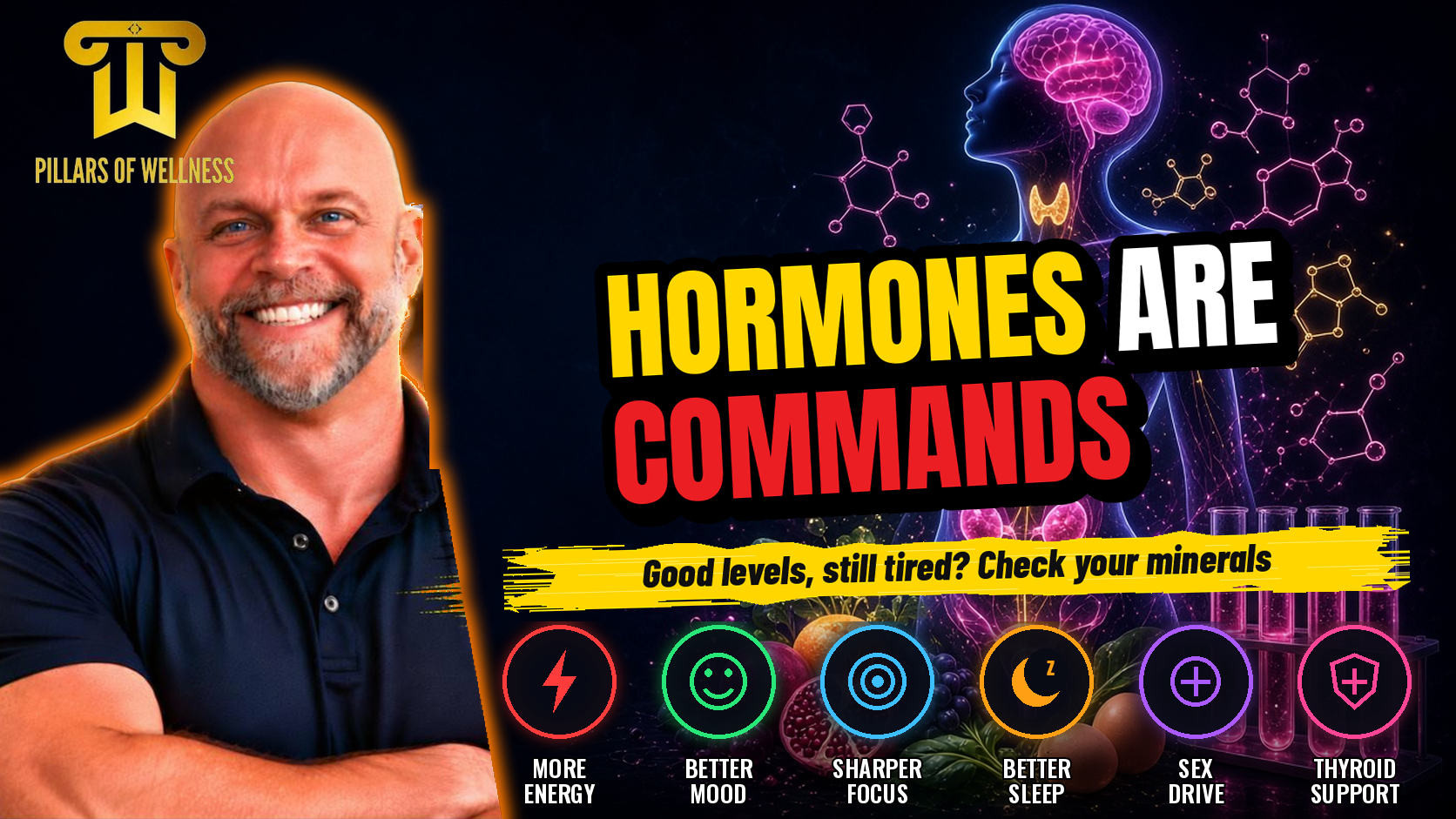
In this episode, Dr. Matt Chalmers, DC, CCCN, CCSP, tackles one of the most frustrating situations he sees in practice: women (and men) whose hormone levels look decent on paper, yet who still feel tired, foggy, moody and stuck. His answer starts with a simple idea he returns to again and again: hormones and peptides are commands. They tell the body to build a pathway or run a process. But if the raw materials aren’t there, the job doesn’t get done.
Using thyroid hormone as a clear example, Dr. Chalmers walks through how minerals like selenium, zinc and magnesium make hormone activation possible, why birth control and other common prescriptions can quietly drain those nutrients, and why a truly holistic approach looks at hormones, nutrition, toxins, sleep and stress together instead of one lab value at a time.
Think of a hormone as an order: “bake me a cake.” If there are no eggs in the kitchen, there is no cake. Many people who come in with near-normal hormone levels still feel fatigued because their bodies lack the nutrients needed to carry out those orders.
Most thyroid hormone is made as T4, the storage form. Converting T4 into active T3 (by removing one iodine) requires selenium, zinc and magnesium, and those same minerals help T3 get into the cell to do its job. Low minerals can mean feeling hypothyroid even with “normal” thyroid labs.
Dr. Chalmers’ favorite fix is food. The nutrients that run a human body are the same ones that run a cow’s body: selenium, zinc, magnesium, iron, CoQ10, amino acids and complete protein. Steak and beef liver deliver them in a form the body recognizes.
Birth control is his go-to example: it depletes selenium, zinc and magnesium, the same minerals thyroid function depends on. When energy drops, weight climbs and mood sinks, the answer is often more prescriptions instead of refilling the nutrient “bucket.”
Before chasing nutrition, make sure hormone levels are actually where they should be. For women, he typically starts with testosterone, then balances estrogen and uses progesterone to support sleep, adjusting based on how she feels and functions, not just a reference range.
When the body is fighting toxins (alcohol is the easy example, along with exposures like glyphosate, atrazine and PFAS), it spends nutrients on clearing them first. That can leave too little for everything else.
Holistic means looking at the whole body. Change one thing, like adding testosterone, and estrogen, water retention and nutrient needs can all shift. Medical tools still have their place. The goal is to anticipate what moves next.
If your hormone provider never talks about diet, supplementation, sleep or stress, you may be getting only part of the benefit. Hormones plus the right nutrients is where most people finally feel like themselves again.
The overarching message: you are a chemical equation. Hormones give the commands, and nutrients make it possible for your body to follow them.
Related: The Testosterone Truth: Why Medicine Doesn’t Want You Healthy · WIN Your Health: A Women’s Health Workshop
Transcript lightly edited for readability (filler words and repeats removed). Specific dose amounts have been removed.
All right, so still can’t post about stuff on Instagram. I can’t go live on Instagram because so, which is fine because I’m talking about women’s health thing in a day, which would probably be banned again. So it is what it is. One of the things that we need to make sure I say this a lot, but we need to make sure that we kind of go into it is hormones and peptides are commands. They tell the body to do a thing, you know, build this pathway, you know, run this process, bake me a cake.
And if you don’t have any eggs, you can’t bake a cake, which has this all the time. So we get some women who come in, women and men, but usually it’s women. It’s about 80% women when they come in and their hormones are not that far off. They’re not really that bad, but they still feel tired. They still feel fatigued. They still have emotional issues, things like that. Hormones are really important. You got to get more. They’re supposed to go that whole thing.
But if you don’t feed the body, right? You’re still not going to get where you’re trying to go. So make making sure that you get one of the biggest things I see that people miss as is usually minerals. So selenium, zinc, magnesium, iron, you know, potassium, sodium, that type of thing. Getting those in is really important. So let’s just real quick. We’ll just look at thyroid. Okay. So not testosterone. Just look at thyroid. So your body makes thyroid hormone and makes T four and T three T four is the inactive form that is ready to be turned into T3 and go out and do the job.
So you have a lot of T4 floating around. It’s like 80% of what you produce is T4 because it’s the one that’s ready to go. And what ends up happening is that when your body goes, hey, we need some more T3, your body goes through a process called deiodination. What that means is that it takes one of the ions off. Basically it takes one of the iodine off the T4 making it T3. So you have four iodine to take one off, you’ve got three iodines. So you got two, three, that process requires minerals, specifically as the names, selenium, zinc and magnesium.
Iron’s a big player in this too, but not as big as those three for this specific issue. Once that’s made into T3, you got T3 float around your body and that’s awesome. However, it’s supposed to get into the cell to activate the nuclear function. So the body chain makes changes in protein replication and the whole deal. Right? So how do we get in the cell? Selenium, zinc and magnesium. So you’ve got to have these levels high enough that the body can do all the processes it’s supposed to do.
So we’ve got, we get women in all the time, this is again, mostly women, who have, who are on levothyroxine, but they’re not getting the results they want. Well, we start giving the body the mass amounts of vitamins and minerals back in so the body can complete the entire biochemical process, the whole metabolic process. And all of a sudden they feel fantastic. So one of the things that you’ve got to start looking at when you’re, when you’re doing hormones. And the thing about this is that it’s not every woman, I’d say probably, I don’t know, maybe 20% of women who are on hormones are going to get some benefit, but then there’s a gap.
And so what we’ve got to do is we usually what we’ll do is we’ll bring them and we’ll test them. Like I use muscle testing for that. It’s the best option when we go through my guy, here’s now what’s going on. We can reset those things and get back to where you’re supposed to go. So if you’re, if you’re, if you’re working on your hormones and you’re seeing some benefit, but you’re not seeing where you really want to go, that’d be the first thing I would check is, okay, how much, you know, how much nutrients do we have?
Because again, you’re a chemical equation. And so if you don’t have enough of a vitamin or mineral, you’re not going to complete that function. So this is one of those things that you also, again, you’ve also got to tie in. Now, I usually will try to fix this by just having people eat stuff. My favorite thing for this, and I realize the government and all the people who are out there who are going to argue with this, but you’re arguing literally with chemistry and literally with facts, so have fun.
Red meat, steak, beef liver, those sort of things are the best things you can eat to solve all these issues, because guess what? The things that make our body run are the same things that make the cow’s body run and the selenium and the zinc, the magnesium and all the proteins and amino acids and CoQ10 and iron and all the things they’re in steak. They’re in beef liver. You don’t have to take a bunch of supplements. If you’ll eat the steak and eat the beef liver and that type of stuff, it’ll help you tremendously.
Which is why a lot of times we see people who go on like a carnivore diet, all of a sudden, all these issues they had start going away because the vast majority, again, chronic disease in this country is the number one thing we spend money on, 90% of all the dollars spend on health care go to chronic disease. The vast majority of chronic disease is either hormone or nutrition deficiency. Flat out. You know, you look at chronic fatigue, you look at fibromyalgia, you look at, you know, erection issues, you look at depression, you look at, you know, a lot of the other mental health things. Those that’s testosterone, hot flashes, night sweats, vaginal dryness, UTIs, that’s estrogen, to a large degree.
All right. Well, the medical community is doing nothing. They do everything they can to not do what’s supposed to be done with that. And so we maintain this giant, you know, piece of disease, those hormones back in. Great. Now we’ve gotten the commands back in the tell the body, hey, go do this thing. All right, cool. Does it have the chemicals required to do the thing you’re asking it to do? That’s the nutrition piece. And so if you’re working with somebody on hormones and they’ve never talked about your diet, they’ve never talked about supplementation, they’ve never talked about, you know, nutrient intake and things like that might be why you’re having problems.
So now having said that we have lots and lots of women who come in and all we do is fix their hormones and they get phenomenally better. However, again, this is one of those things. This is one of those experience things which you’ve worked with enough people. I’ve been doing this for 15 years where you’re like, your levels should be good. And what you’re telling me seems a little odd. Why don’t we look at nutrient function? And we go through that and all of a sudden things start getting better.
And there’s tons of drugs. We talk about this a lot. There’s tons of drugs and things that people take that deplete these nutrients. And so you’ve got to give the normal amount plus the buckets empty. So you have to give a little bit to fill their bucket, and then you have a lot more because they’re selling that medication. Birth control is the one I use the most as an example. Birth control depletes selenium, zinc, and magnesium. We just talked about that’s thyroid.
So, you know, then thyroid comes down, energy comes down, weight starts coming on, depression starts coming up. And so where do you get SSRIs? Because you’re crazy. No, you have nutrient deficiency. Now your doctor’s not going to tell you that because telling you to go by supplements or telling you to eat better is not going to keep funneling all the money into the pharmaceutical and medical function. The reason they’re not going to tell you this isn’t because they’re bad people.
They have no idea. They get no education in nutrition, no education on hormones. Well, they do get educated hormones, but they’re told is that hormones cause cancer. Don’t use them and don’t let anybody use them on other patients. So they’re actively to this point that it’s breaking down a little bit, but up to like January of this year of 2026, they were actively being taught do not do hormone therapy, it will cause cancer in your patients. So which is a lie.
It’s not true at all, but keeping people sick is kind of the goal of our medical policy right now, because if you’re sick, you have to go back and do the tests and buy the stuff and do all the things. So great. But that’s where we’re kind of adding this. So if you’re, if you’re looking for your hormone issues, if you’re like, look, I’m on some of this stuff is you have to be the right levels first. So let’s start there. Like if you’re on a little bit of testosterone and you’re a woman, your testosterone levels are 50 and your estrogen, you’re taking a bunch of estrogen and [dose removed] of progesterone and you’re like, I don’t know what’s going on.
My cycle’s weird. I’m not very, I don’t have the energy, my sex drives crap, but I’m on these hormones. Your levels might be wrong first. You got to get that testosterone levels up the way that I recommend you do it. You start with testosterone, get a high enough level so that your trough days and you know, between 120 and 200, depending on how you feel, check all the boxes on testosterone, then see how many of the boxes on estrogen got checked, move in with either patches or creams or injections, however you want your estrogen, balance that.
You can balance the progesterone on sleep while you’re doing that. But if you’re doing this process this way and you’re starting to get good functional results, but you’re starting having a little bit of problem, look at what’s going on nutritionally. So we’ve had, we’ve had lots of anemia, lots of anemia. We’ve had lots of things like selenium and zinc that be low. We’ve had a decent amount of B vitamin stuff, B vitamin issues, and we’ve had tons and tons of toxicity problems.
So when you have a toxicity problem, your body’s going to use all of the nutrients it has and everything it has to push back against the toxicity problem first. And then so you might be running out of stuff because of the toxicity issue. Easiest way to explain this is alcohol. So whenever you drink, your body stops doing everything it’s doing and goes, get rid of this alcohol. And so that’s one of those things. That’s why it’s so damaging to, you know, losing fat or getting muscle and things like that.
So as you’re going through these, like a lot of the toxins we’re bringing in our food, water and air that we don’t even really know about. So it’s not really your fault. Those type of things you’ve got to deal with. So if we’re looking at glyphosate, atrazine, or looking at PFAS, you’re looking at all that type of stuff. Sometimes you got to pull that stuff out as well. So this is a little bit bigger than just take your patch and call it a day if you really want to get where you’re trying to go.
The vast majority of women, you get their levels where they’re supposed to be. You talk to them how they feel. You can do most of this with hormones. However, I would always recommend that you look at your diet and you look at your exercise and you look at your sleep and you look at your stress no matter what. And we’ve got we get deals where we do kind of all those things, but we just did a streamline when we don’t do diet, exercise or stress. We just do the hormones with a little bit of nutrition.
And it’s been, it’s been working pretty well, but that’s the thing you have to make sure of is that sometimes your hormones are in a decent place, not maybe not optimal, but they’re in a decent place. If you’re not getting any results at all, it’s one of those little things, exercise, diet, sleep, stress. So walk through that. If your provider doesn’t understand that those things and isn’t working with you on them or isn’t even doesn’t have them as a in the minute, we’ll work on this stuff. Like for instance, there’s a lot of stuff people come back, why don’t you pull thyroid on your everyday labs?
Well, because one, it takes a long time to get those labs back. So we have to wait like an extra five days, get started. But two, the other thing is that the vast majority of the time, even when we pull people’s labs in their thyroid, it’s not where it’s supposed to be. Because of what we’ve done with the testosterone, the estrogen, progesterone, and all the supplementation, the thyroid takes care of itself. So we don’t really need to worry about that.
Because again, when you reset the body back to original design, you give it the hormones it’s designed to function with, you give this nutrients It’s supposed to it’s needs to have to do all the things you’re asking us to do lots of things in the body get better This is a holistic viewpoint. We’re looking at the whole body all at once holistic and natural are not the same thing For instance, we’ll use medical drugs all the time. Diflucan, nystatin. There’s other ones that we can throw in there that kind of helped get us back where we’re trying to go antibiotics Are fantastic if we have a major antibiotic issue But holistic means we’re gonna look at the entire body and be like, okay Like when we move, when we lift the pool table up on this side, where are all the balls going to move? Not just this one, what’s going to happen to everything?
So for instance, if you give somebody testosterone, where’s their estrogen levels going? Where’s their water retention going? What’s their nutrient demands going to be? You know, those types of things. Like as they start detoxing, what are we looking for? So that’s kind of where a lot of this stuff goes is what’s the next thing down the line that this is going to affect and how is it going to affect the entire body? So looking at that pathway, you’ve got to start bringing in nutrition and if your hormone people are not even talking about nutrition, they’re giving you maybe 40% of what you need hormone wise, if they get all the hormones right.
So keep that in mind, yes, nutrition is for sure a thing. So anyway, look at your nutrition. If you guys are not, supplementing, you’re not being worked on with supplementation. If you’re not being at least discussed supplementation with your providers, you’re probably get it. You’re not getting the entire package. You’re definitely not getting the entire picture of what you need. So keep that in mind. If you’re still like, Hey, I’ve got some hormones and I’m usually okay, but some days I’m man, you know, give us a call.
All we can walk through yourself, your supplementation, your stress, your sleep, and all the other stuff. You guys have a fantastic day. Thanks for your time.
Check out PillarsOfWellness.com for Wellness updates! And ask me any questions you have at questions@chalmerswellness.com.
I answer them all and look forward to hearing from you.
Comment, like, and interact with other people on their wellness journey. Communities can make a difference. DrChalmers.substack.com
Check out my website: https://pillarsofwellness.com/
Social Channels: Instagram: https://www.instagram.com/drchalmers1/
Facebook: https://www.facebook.com/ChalmersWellness
LinkedIn: https://www.linkedin.com/in/matt-chalmers-a422803b/
Dr. Matt Chalmers
Disclaimer: This content is for informational purposes only. Before taking any action based on this information, you should first consult with your physician or health care provider. This information is not intended to be a substitute for professional medical advice, diagnosis, or treatment. Always seek the advice of your physician or other qualified health providers with any questions regarding a medical condition, your health, or wellness.