UPCOMING ENGAGEMENT
Dr. Matt Chalmers, DC, CCCN, CCSP, returns to Life University for a full-day seminar on bringing peptides into clinical practice, hosted by NutriDyn.
Hosted by NutriDyn · Saturday, October 31, 2026 · 8:30 AM – 4:30 PM · Life University (CCE Building), Marietta, Georgia
The seminar is open to DCs, MDs, NDs, NPs, DOs, registered dietitians and chiropractic students: anyone who is part of a patient’s journey in a practice.
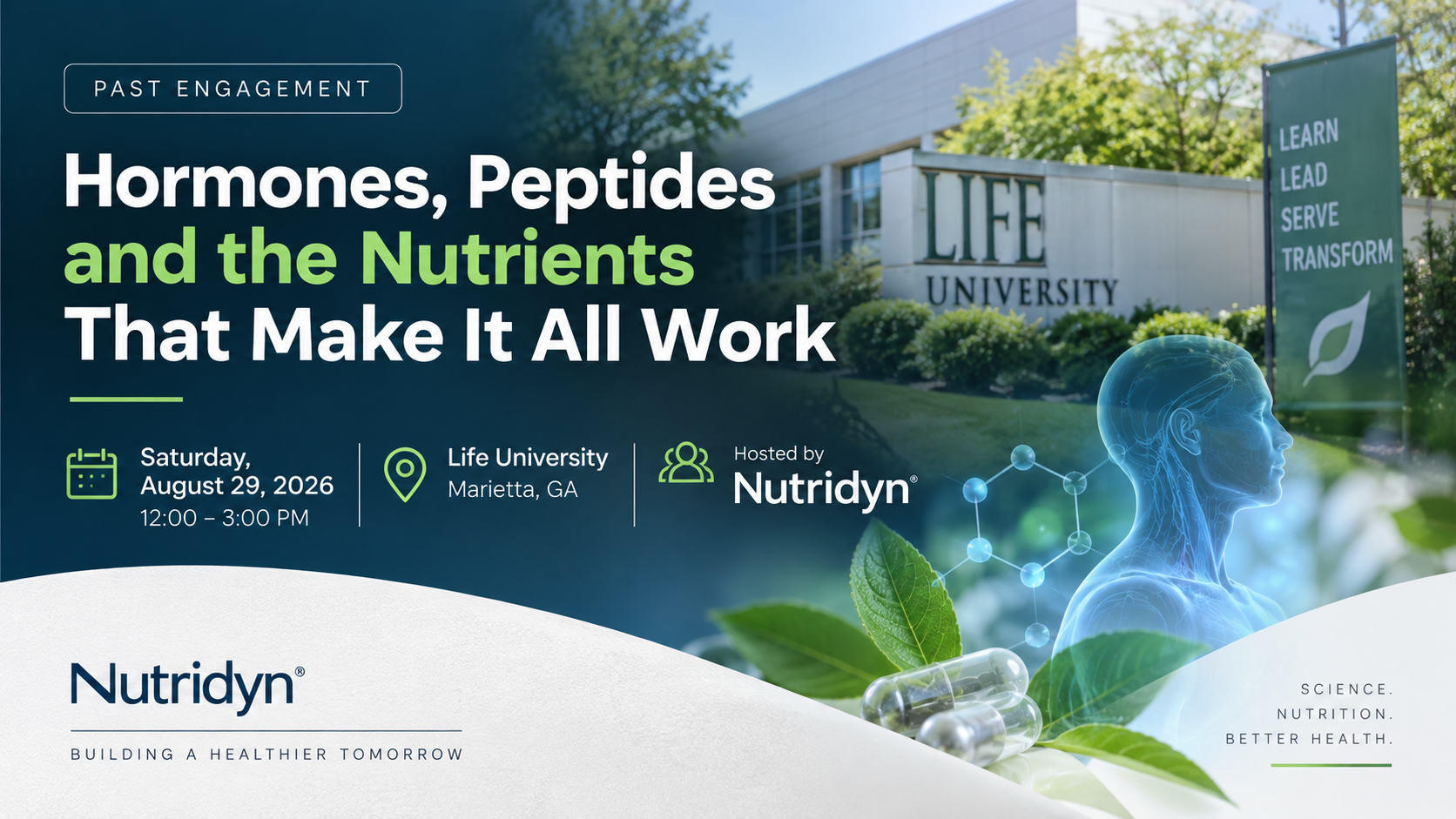
This is Dr. Chalmers’ second seminar at Life University. Read about his first talk: Hormones, Peptides and the Nutrients That Make It All Work (August 29, 2026). See all speaking events.
Dr. Chalmers sat down with NutriDyn to preview this seminar. Watch the interview below.
Dr. Matt Chalmers with NutriDyn, previewing his October 31 seminar at Life University. Transcript generated from the video and lightly edited for readability.
NutriDyn host: We’re super excited to have Dr. Chalmers come to Atlanta, Georgia. He came once, which was amazing, but usually a sign of someone liking you is they want you to come back, right? Not the “I’ll call you.” The feedback was so great that individuals said, “Hey, we had time. We need more time.” And so we’re really looking forward to it.
Where we’re going to be is at Life University. A little tidbit on Life University: it is the largest chiropractic college in the US. So when we have support from a school like that, it really says a lot. And when it comes to a topic like peptides, they wanted to jump on it, and the students loved it last time, so we’re looking forward to it.
It’s going to be at 1325 Barclay Circle in Marietta, Georgia. That is on campus, in the CCE building. We’re going to have breakfast and lunch there. CEs will be available for DCs, and they’re going to be able to get 7 hours. So if you’re looking for that, that’s something you’ll be able to take advantage of.
We’re not only going to be talking about peptides. What I appreciated the most last time was the in between, right? It’s the labs and all of that, but it’s the in between. It’s the clinical. It’s the anecdotal. It’s the experience that we get from Dr. Chalmers that really is the highlight, and what a lot of people took away as far as using it practically.
And the nutrient gap. I work with NutriDyn, where we make medical-grade supplements for all disciplines, but we started off as a chiropractic equipment company, so we’re always going to be faithful to our chiros. One thing that was really clear is that the peptide is the signal. It’s the call. It’s the memo. But if you do not have the building blocks or the materials to complete the call or complete the signal, it’s going to be for naught. So that’s where it’s the marriage between NutriDyn, our protocols, our supplementation, our diet and lifestyle, with what we’re going to learn from Dr. Chalmers about these various peptides for a variety of different uses.
Dr. Matt Chalmers: Yeah, it’ll be great times. Like you said so beautifully, the biggest thing we’re seeing right now, from all the damage and all the low results from these peptides, is that people don’t know they’ve got to add in the nutrients to make the commands do something. So that’s been a big piece that’s been really fun to walk through.
Now that we have more control over the metabolic system, we can command it to do a whole lot more. From the position we’re sitting in now, we can fix the root cause of so many different problems. We’re able to handle insulin resistance, we’re able to increase nutrient function, hormone function, absorption. So it’s really fun getting to play with this stuff.
The other thing that’s always fun for me is trying to figure out, okay, how are we going to introduce this into our practice? How are we going to make what we do and who we are already better? So there’s a bunch of integrating-it-into-the-practice type of stuff that’s always fun, because I sat down with a bunch of guys and we talked about the different ways they could integrate it into their practice. So it’s a good time, and I love meeting with all the students. I’m excited about coming back.
NutriDyn host: What was your biggest takeaway? We had a variety of disciplines. We had MDs, we had nurse practitioners. Like you just said, we had students, we had DCs, we had registered dietitians there. If there was a big surprise, what was your biggest surprise as far as a knowledge gap that was present with the attendees?
Dr. Matt Chalmers: The big thing we get into is that hormones have not been taught very well by anybody, which is really sad, because they’re so unbelievably beneficial to quality of life and just function. So that’s probably the big thing: we don’t have that base, and going through that is beneficial.
What I always love is when you get in a room like this, it doesn’t matter if there are chiro students, or, like you said, MDs and NPs and everybody. Everybody was just trying to figure out ways of helping the people in their practice. That’s always awesome to be around, because when your whole goal is “I want to come learn so I can help more people,” it’s always awesome. So it was a whole lot of fun to be part of that. That was probably the big takeaway: all the fighting and all the stuff all around, the vast majority of us don’t care about that. We just want to get people better.
NutriDyn host: And what would you say to those who… I’ll just speak locally for my territory down here in the Southeast and the doctors we see. We have a variety of situations where some DCs can’t bring it into their practice, so they set up a medical office. And there are some practitioners whose scope maybe doesn’t allow them. Why still come to a seminar on peptides?
Dr. Matt Chalmers: Well, the thing is that the laws are going to change. These things are so unbelievably beneficial, and people just don’t really know. There’s just not a chance in the world that they’re going to maintain this “you can’t use them in your practice” thing for very much longer.
I get to tell people they’re not diabetic all the time. It’s not a random thing. It’s just a normal thing I do on Tuesday. It’s always awesome, but I get to tell people all the time, “You’re no longer diabetic.” And this is a funny one, because I’ll say, “You’re not diabetic anymore,” and they’re like, “You know, that’s cool and all, but my favorite thing is that my memory is so much better.” And I’m like, “Yeah, you had some dementia too.” And they’re like, “What?” And I’m like, “Yeah, that’s where insulin resistance goes. Type 2 diabetes, dementia.” And they’re like, “Oh, my God.”
So when people start recognizing what we can do with these, everyone in the country is going to want to be able to use them. The other thing is that if you come and get a mastery knowledge of it, you can do telemedicine in different places. You could move. I would move for this technology. If it was, “Hey, Texas is no longer going to allow this, but I can do it in Oklahoma,” I would move to Oklahoma and do telemedicine from there. That’s how important this is to what I do. So it’s a big, big deal, and like I said, it is coming everywhere, so you might as well come learn it now, because if you don’t, you’re going to be way behind everybody else.
NutriDyn host: One thing I’m seeing in the field is peptides in adolescents, in pediatrics. Any experience with that? Where I’m leading towards is really autism. I’m seeing a lot of our practitioners, because of the results they’re getting, willing to… And again, one of my practitioners says it takes four people to hold them down when the needle comes out. Even though they’re little kids, they have the strength of eight men. But what are you seeing when it comes to peptides in pediatrics, for my pediatricians and for my clinics that see that population?
Dr. Matt Chalmers: There’s a whole bunch of things we can do with the little kids, as well as some of the teenage kids. For the little kids, what we’re seeing is that we can start cleansing some of these pathways a little bit easier, resetting this insulin resistance stuff, resetting some of the problems we’re getting from inflammatory damage. There are a couple of different ones we’ve been using. Serrapeptase is really good for this. I like Selank and Semax for this, even though that’s not really their big bag. But we can also start really winding down the inflammatory response, and that’s been beneficial for this whole thing as well.
When we start gravitating into the teenage years, here’s what I’ve done for my son. My sleep apnea for 20 years was so bad it was giving me epilepsy, and nobody really figured that out. My son, who has my genetics, was starting to come up, and he started snoring. And I was like, “Nope, we’re not playing this game.” So I used peptides on him when he was 13. It eliminated that visceral fat, and his snoring stopped. His sleep apnea went away just like mine did.
So that’s a big piece. There’s a whole bunch of kids whose parents I talk to who are like, “Oh, yeah, they snore.” And it’s a big deal. Hypoxia from sleep apnea is one of the biggest problems we see driving insulin resistance, driving all kinds of cardiovascular problems, all sorts of stuff. So there’s a whole bunch we can do with these kids, and a lot of this stuff is not these kids’ fault.
You look at a 13- or 14-year-old kid and people say, “Well, they’re fat.” All right. I get that 13- and 14-year-olds left to their own devices are probably not going to make the best meal decisions. But at the end of the day, the parents played a lot into that. The chemicals in our food, water and air played a ton into that. So if you’re 13, 14, 15 and all of a sudden you’re 50 pounds overweight, all right, for the health of the child, let’s start changing this metabolic function.
And then the fun stuff comes in, where we’ve got some parents who are like, “Look, my son was going to be 5’9″, and we now have the ability to make him not 5’9″, maybe 5’10” or 5’11”.” And so we took advantage of that. I tell people all the time, I’ve got two boys, and my job as a dad is to prepare them the best I can for the world they’re walking into. And if being 6’3″ or 6’4″ is better than 6’1″ or 6’2″, then that’s part of what we’re going to do. I realize people think that’s a little weird, but again, just Google it: what are the pay rates, what about attracting mates, for a 5’9″ guy versus a 6-foot-tall guy? That’s just how it is.
So there are a bunch of really neat things going on. The nice thing is that now that we’re working with the body’s physiology instead of against it, all these things are a lot safer to do. There’s a whole lot easier way to do this, because we fully understand the pathways and we can support them in all different ways. So it’s been a lot safer, and it’s really fun to do this stuff with these kids all the way through. We’re also seeing a lot with autoimmune function with Thymosin Alpha-1. We’re seeing immune regulation coming back down. So it’s been super-duper fun getting to work with all this stuff.
NutriDyn host: Man, that’s awesome. For a practitioner who is brand new to peptides, did they miss the peptide train? Where are we on this spectrum of the GLP-1s and all the peptides? Let’s focus on the GLP-1s, because I think that’s really the entry drug, for lack of a better word, for many of them. For our practitioners who are interested in bringing this in for weight loss, for dementia, for diabetes, for whatever the application, is it too late? There seems to be some type of parity in pricing; it seems to get evened out. Is it too late for the GLP-1 race if you want to get into this?
Dr. Matt Chalmers: Absolutely not. We are just getting started. I had to have a conversation with a patient I have on some GLP stuff, and she’s like, “I don’t want my husband to find out.” And I was like, “What? Why?” And she was like, “Well, he feels like it’s cheating.” And I was like, “Oh my God. No.” I had to walk them through it: this is the healthiest thing you can do for your metabolic health. Resetting your insulin, glucagon, resetting your insulin resistance. This is way more than losing weight. This is way more than losing weight.
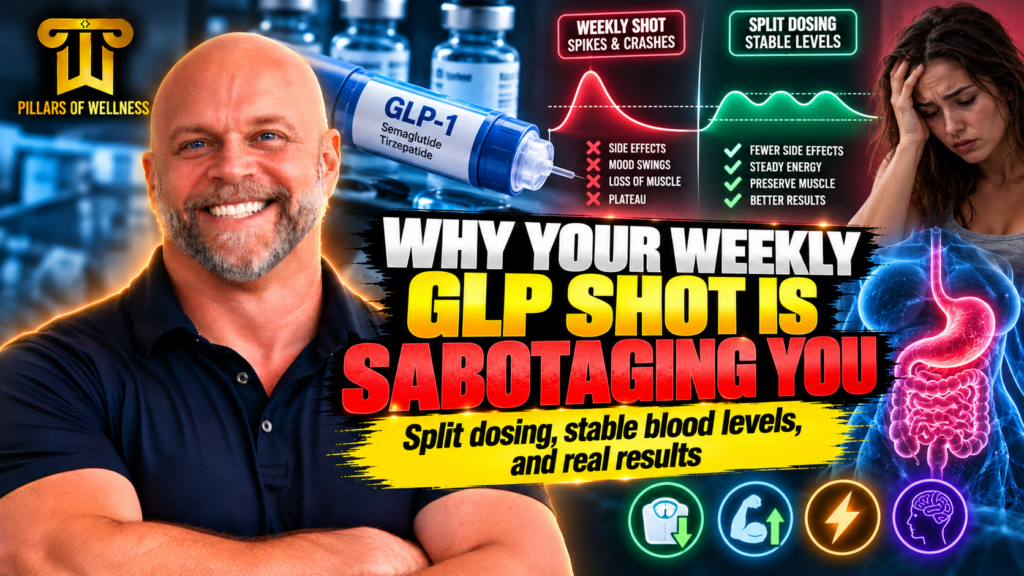
Again, our food, water and air have been poisoned. We don’t have nearly enough nutrients to get by, which is why we have to actually supplement. So when you start looking at the reality of where we’re at, everybody needs these to some degree. And it’s one of those things where people don’t even really know how to use them yet, because we still have people using them once a week. You never really want to do a hormone therapy at its half-life, and GLPs are about 6 days, so doing it once every 7 days is not the best idea. We’re seeing lots of damage from that.
But once everybody starts understanding how they work and what they are, as a tool, they’re amazing. We haven’t even really scratched the surface on this yet. There are a million people within 45 minutes of my office who need this stuff, and I couldn’t service all of them if I tried. It is the very, very beginning of this. And as people learn to do it better, the results are staggering. So no, it’s not too late at all.
NutriDyn host: Awesome. We’re coming down to the end of this. One question, since this is going to be at Life University: let’s ask a question for our DCs. “Dr. Chalmers, I’m a DC. I believe that my hands are going to be the thing that elicits change. I remove subluxation, I activate DNA, they’re going to heal from the inside out, and I’m going to allow the body to do what it’s supposed to do. That’s what I was taught in school.” Where do peptides fit for someone who has that type of philosophy? It’s not wrong. We believe that.
What I’m getting at with this question is expanding the mindset of some of our DCs local to our area. Supplements are a big jump for them, just the fact of bringing in supplements. But now we’re talking past supplements. We’re going to go to peptides that are going to elicit a change. Where does this fit specifically in a DC’s practice?
Dr. Matt Chalmers: When I started, it was really big, the power that made the body heals the body. Healing comes from above down, inside out. What I’ve always translated that into is that we need to always look back at the physiology. As a chiropractor, our thing has always been: how was the body designed? I want the body to do the work, because the body has the innate intelligence to actually get us where we’re trying to go.
Cool. Well, here’s the thing. The more physiology we learn, the more we find, oh, by the way, your testosterone is hypercritical to function throughout your entire body. It’s not a drug. God created testosterone; man didn’t. It is a nutrient, a critical nutrient. We’ve got to get that where it’s supposed to be. Okay, great. By the way, that insulin, because of the chemicals, is killing you. We have to fix that insulin to get you back to physiology, back to the way you were designed to function. The closer we get back to original design, the more power you give the innate intelligence, and the easier it is for the body to heal.
And that’s true all the way throughout chiropractic. When there’s pressure on nerves, that whole idea, we’ve got to open up the communication so the body can restore function back to original design. The lymph has to flow, the blood has to move, nerve conduction has to happen, and that’s great. But just like nerve conduction has to happen, you’ve got to give the body the chemicals for it to function. If you don’t have the sodium-potassium function, if you don’t have the different ionization, you’re not going to get where you need to go. So now we’re talking about minerals.
All right, great. Here’s the thing, and I’m not trying to call anybody out. As the doc, someone comes to you to get help, and you talk to this 16-year-old girl who has depression now, and you go, “Oh, you’ve been on birth control for the past year and a half. You’re probably out of selenium, zinc, magnesium. I can give you all those nutrients back, because those are the chemicals those drugs push out of your body. I can restore your physiology with the minerals your body was supposed to have, and now we’ve taken you back to original design.”
So that’s always how it’s been for me as a chiro: my job is to get back to original physiology. I’m going to adjust you for it. I’m going to teach you to exercise and stretch and how to move things so we keep full function and flow in the body. I’m a big AK guy, so we use a lot of AK, especially with nutrition, because it’s the best. I’ve got access to every blood lab and everything in the world. Muscle testing is by far the best way to do it for nutritional function, so we do a lot of that. But at the end of the day, I’ve got to get the chemistry back to original design, and the peptides and the hormones and the supplementation are the only way we can get that done.
So it just kind of depends on the chiro. There are a lot of great chiros I know who are like, “Look, man, I’m going to adjust, and that’s all I’m going to do.” I’m like, “That’s awesome. That’s great.” And then there are some other guys who, when people come in and say, “I need your help,” say, all right, I’m going to be the doc.
And that’s kind of how it happened with me. When I started this off, I had a bunch of 50-year-old women come into my office and try to buy calcium and D3. When a 50-year-old woman buys calcium and D3, we all know why. And I’d say, “Hey, ma’am, by the way, this isn’t going to help your osteoporosis.” And she’d say, “What are you talking about?” You need the testosterone that tells the calcium to go in and build the bony matrix. The osteoblasts listen to testosterone. They’re going to pull the calcium out of the blood and actually build bone out of it, so you need the testosterone.
And then for about six months, I had dozens of women come back and say, “My doctor said that testosterone’s a man’s hormone and women don’t need it.” And I was like, oh my gosh. Women don’t make estrogen. They make testosterone. They convert testosterone into estrogen through aromatization. So to say that a woman doesn’t need testosterone is basically telling me you have no idea how hormones work. Not even the first clue. So I was like, fine. We started doing hormones for women because nobody else was helping these people. I know how to put the physiology back where it’s supposed to be, so this is where I’m going to go.
So I get it 100% from all the chiros on both sides. But at the end of the day, you might be the only person who can get this stuff to your patients, because medical doctors are typically taught how to sell drugs. They’re not taught how to fix the body. And the argument for that is pretty easy: if you look at our chronic disease states, we’re really, really bad now. So the closer we get back to physiology the way the chiros were taught… and that’s just my opinion. That’s how we do it. I respect the guys who are like, “I’m going to adjust with my hands and nothing else.” I get that, and that works, but this is kind of how I took it.
NutriDyn host: Awesome. Again, we’re looking forward to having you October 31st, from 8:30 AM to 4:30 PM. We’re going to have breakfast. We’re going to have lunch. But more importantly, we’re going to have up-to-date information on peptide use, how to bring peptides into your practice, and more importantly, how you’ll be able to apply that on Monday. So Dr. Chalmers, we’re excited to have you come from Texas all the way to Atlanta. Just like last time, we had a blast. The turnout was amazing, and so was what I was able to hear from people about it afterwards. And again, just around two months later, they want you back. So take that as a sign that you did a really good job. We’re looking forward to going over all the classes, right? Not just the GLP-1s and the secretagogues and all of those. We’re going to go really, really deep into all of these and how we can apply them.
Last question. For those who are going to be watching this, practitioners in the Southeast getting ready for your event, what is your message? What do they have to look forward to?
Dr. Matt Chalmers: The big thing is that we’re going to dispel some myths. I’m going to walk you through it. The big question people always have is not, “Hey, I can go read this stuff myself. I can look it up.” It’s: walk me through how to use it. Walk me through, “Hey, here’s what you need to watch out for with your patients. This is going to happen, and no one’s going to tell you about it, but this is going to happen sooner or later.” So I can walk you through all those things. We usually walk through, “Hey, here’s what you’re going to look for. When you look at the blood, this is actually what you’re trying to do. When your patients tell you this, ask them these questions, a little bit deeper questions, so we can make sure we have safety function.”
That’s the big piece, because we’ve been working with hormones and peptides with pro athletes and soccer moms for years now. And the things to look for, the things to watch out for, a lot of this stuff isn’t written down. For instance, for the hormone thing real quick, for women: you can give a woman testosterone and it converts to estrogen, but it won’t show up in our blood labs, even though it knocks out all of our low-estrogen problems. Well, that’s because it converted in the uterus and the ovaries, not in the blood. So if you pull blood, it’s not there, but it’s in the uterus and ovaries. You don’t necessarily need to give them more.
So there are lots of things like that from a clinical perspective that we’ll walk through. And it’s always funny, because I’ll walk docs through this and they go, “Oh, that makes so much sense.” I teach hormones and peptides for one of the pharmacies I work with, and we’ve taught, gosh, several hundred med spas and medical offices this year. It’s really fun, because they’ll come in and you can just watch their minds putting all the pieces together, and they’re like, “Oh, now I get it.”
So the big thing you’re going to get, that you can’t just read, is that we’re going to walk through how this works on your patients, what to look out for and how to tweak things. We can walk through what typical doses look like and all that fun stuff. So there’s going to be a whole lot of clinical information. If you want this in your practice, this is the thing to come and talk about.
NutriDyn host: Well, listen, Dr. Chalmers, on behalf of NutriDyn, we’re excited to have you come in. And practitioners, when you get this video and when you get the outreach, we would love to have you. Again, 1325 Barclay Circle in Marietta, Georgia. We’re going to be on Life University’s campus in the CCE building. NutriDyn is bringing another great event. We’re going to have food there. CEs will be available for chiropractors, but all disciplines will benefit from this: MDs, NDs, nurse practitioners, osteopaths, registered dietitians. Anyone who is part of a patient’s journey in a practice is going to benefit from this. So again, Dr. Chalmers, travel safe, and we look forward to having you October 31st.
Dr. Matt Chalmers: Awesome. Can’t wait for it. Talk to you guys soon.
This interview reflects Dr. Chalmers’ clinical experience and is intended for healthcare practitioners. It is educational only and is not medical or legal advice. Patients should work with a licensed provider before starting or changing any medication, hormone or peptide therapy.
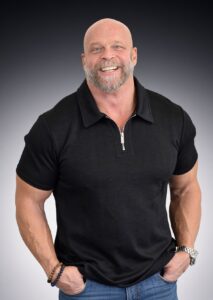
Dr. Chalmers is the founder and Metabolic Wellness Director of Pillars of Wellness in Frisco, Texas. He has spent nearly twenty years treating metabolic, hormonal, and inflammatory problems. He is a TEDx speaker, the bestselling author of Pillars of Wellness, and the host of The Dr. Chalmers Show. National media outlets regularly call on him as an expert in weight-loss medications and peptide therapy.
This event is hosted by NutriDyn, a maker of clinical nutraceuticals sold only through practitioners.
NutriDyn Website:
nutridyn.com
Interested in having Dr. Matt Chalmers speak at your next event, conference, or professional gathering?